Spec 02 · the ranking · STANDARD v2026.8
Best website builders 2026: six platforms, one 40-point rubric
Wix leads revision 2026.8 at 32/40, one point ahead of Squarespace. Six builders, one rubric, forty points: every score is the sum of six weighted criteria, published in full, with a comparison chart and dated prices.
Clause index
How the standard works
In revision 2026.8 of the standard, Wix finishes first at 32/40, Squarespace second at 31, Webflow third at 29, Shopify and Hostinger level at 28, and GoDaddy last at 22. Wix is the default for most small sites. Skip it if you expect to move your site later, because Wix exports nothing; Webflow is the only builder of the six with a genuine code export.
The best website builder is not decided by preference on this page. It is decided by a total out of 40. Six platforms — Wix, Squarespace, Webflow, Shopify, Hostinger and GoDaddy — are scored against the same six criteria, carrying the same weights, in every revision of the standard. Ease of use carries 8 points, design and templates 8, SEO and performance 7, value for money 7, ecommerce and extensibility 5, and support and lock-in 5. The weights sum to 40.
The headline score is the total divided by four, to one decimal, rounded half up. Nothing else adjusts it: no criterion is scored on brand reputation or on what a platform pays. Each definition and weight is set out in the website builder testing methodology. Level totals are split by the higher SEO and performance score, a rule fixed before any mark was awarded. Prices on this page were re-read from US sessions on 9 October 2026; the marks are unchanged from revision 2026.8.
| Builder | Total /40 | Score /10 | From | Wins on | Loses on |
|---|---|---|---|---|---|
| Wix | 32 | 8.0 | $17/mo (Light, yearly) | SEO 6/7 · Ease 7/8 | Support 3/5 · Value 5/7 |
| Squarespace | 31 | 7.8 | $19/mo (Basic, annual) | Design 8/8 · Ease 7/8 | Ecommerce 3/5 · Support 3/5 |
| Webflow | 29 | 7.3 | $15/mo (Basic, no CMS, yearly) | SEO 7/7 · Design 8/8 | Ease 3/8 · Value 4/7 |
| Shopify | 28 | 7.0 | $29/mo (Basic, yearly) | Ecommerce 5/5 · Support 4/5 | Value 3/7 · Design 5/8 |
| Hostinger | 28 | 7.0 | $2.99/mo on a 48-month prepay, renews at $10.99 | Value 7/7 · Ease 7/8 | Ecommerce 2/5 · SEO 4/7 |
| GoDaddy | 22 | 5.5 | $9.99/mo (Airo Starter, yearly), renewal not published | Ease 8/8 · Support 3/5 | SEO 2/7 · Design 4/8 |
Website builder comparison chart: six builders, six clauses
Most website builder comparison charts tick features and leave you to guess which ticks matter. This one publishes the marks behind every total, so you can apply your own weights. Each row below is the six clause marks a builder was awarded, exactly as its own scorecard publishes them, and the total is the sum of the row.
| Builder | Ease /8 | Design /8 | SEO /7 | Value /7 | Ecommerce /5 | Support & lock-in /5 | Total /40 |
|---|---|---|---|---|---|---|---|
| Wix | 7 | 7 | 6 | 5 | 4 | 3 | 32 |
| Squarespace | 7 | 8 | 5 | 5 | 3 | 3 | 31 |
| Webflow | 3 | 8 | 7 | 4 | 3 | 4 | 29 |
| Shopify | 6 | 5 | 5 | 3 | 5 | 4 | 28 |
| Hostinger | 7 | 5 | 4 | 7 | 2 | 3 | 28 |
| GoDaddy | 8 | 4 | 2 | 3 | 2 | 3 | 22 |
Read a column before you read the total. If search matters twice as much to you as the rubric assumes, doubling the SEO weight adds 6 points to Wix and 7 to Webflow: the gap between them narrows from three points to two, but the order holds. If you sell, sort by the 5-point ecommerce column, where Shopify is the only full mark. If nobody on the project can spend weeks learning a tool, Webflow's 3/8 on ease is the number that matters most. The plate below draws the same 36 marks as notched gauges.
Price and renewal side by side
The second half of any comparison is what a builder costs over time and what it lets you take with you when you leave. The entry prices are US list prices read on each vendor's own pricing page on 9 October 2026. The support and export columns restate the evidence in each scorecard.
| Builder | Entry price | At renewal | Free plan or trial | Export | Phone support | Store fee, entry tier |
|---|---|---|---|---|---|---|
| Wix | $17/mo, yearly | Same plan rate; .com renews at $21.35/yr | Free plan with ads on a wixsite.com address | Nothing to rebuild from | Callback only | Light takes no payments; 0% platform fee on paid plans |
| Squarespace | $19/mo annual, $25 monthly | No plan increase published | No free plan; 14-day trial | Nothing to rebuild from | None | 2% on Basic, 0% from Core |
| Webflow | $15/mo yearly (no CMS) | No introductory rate | Free Starter, 2 static pages | Code export on paid Workspace plans | Not confirmed | 2% on ecommerce Standard |
| Shopify | $29/mo yearly, $39 monthly | No plan increase published | 3-day trial, then $1/mo for 3 months | Partial: product data, themes | 24/7 | 2% only with a third-party gateway |
| Hostinger | $2.99/mo, 48 months upfront ($143.52) | $10.99/mo | No free plan; 30-day money-back | Nothing to rebuild from | Not confirmed | 0% platform fee |
| GoDaddy | $9.99/mo, yearly (Airo Starter) | Not published | Free Airo plan, 50 AI credits/mo | Products CSV only | 24/7 | Not verified |
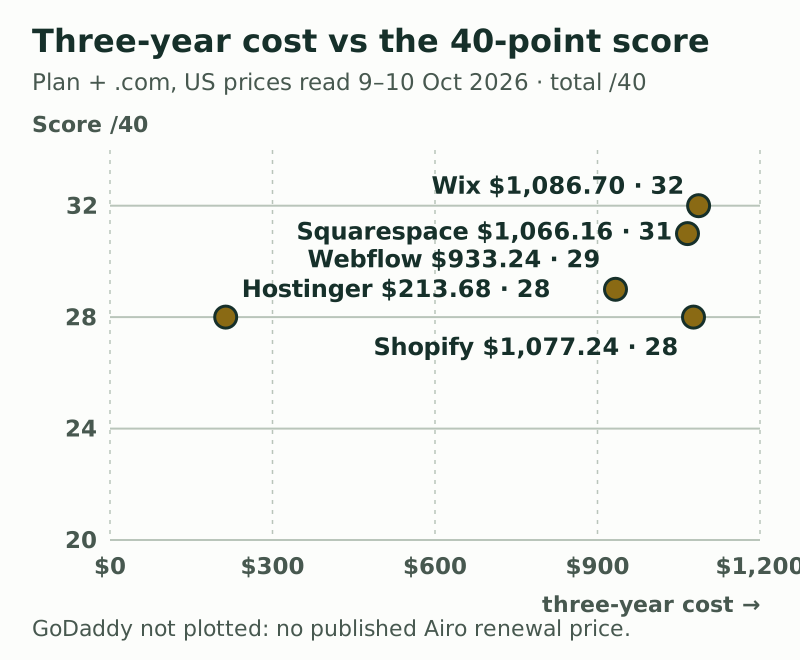
Two things stand out. Over three years, plan plus a .com, four of the scored builders cost between about $930 and $1,090, and the order among them barely moves; Hostinger's Unlimited plan costs $213.68 because its 48-month prepayment covers all three years. And price tracks score only loosely: Wix, the dearest of the four over three years, costs $20.54 more than Squarespace for one more point. The arithmetic for every row is in the website builder pricing breakdown.
The standard in one plate: 6 builders × 6 criteria
Plate I
Wix — 32/40 (8.0)
Wix takes 32 of 40 points and first position. It wins on SEO and performance (6/7) and ease of use (7/8). The SEO mark buys the deepest hosted toolkit of the six: a redirect manager, a structured-data editor, robots.txt control and Search Console integration. In the HTTP Archive Core Web Vitals Technology Report of November 2025, 74.86% of Wix sites passed Core Web Vitals, second only to Duda's 84.87% and ahead of Squarespace's 70.39%.
It loses on support and lock-in (3/5) and value (5/7). There is no direct inbound phone line, only a callback. A published site cannot switch template, so a redesign means a rebuild, and nothing exports. Light costs $17 a month billed yearly for 2 GB, two collaborators and a one-year domain voucher; the $17 to $159 range has no renewal increase, but mailboxes and apps cost extra. Wix meets the standard for most small sites that need breadth without a specialist. Full working: the Wix scorecard.
Affiliate link. We may earn a commission — it never moves a ranking.
Squarespace — 31/40 (7.8)
Squarespace takes 31 of 40, one point behind the leader. It wins on design and templates (8/8) and ease of use (7/8). It earns the design mark differently from Webflow: its templates are good in their stock state, and the section-based editor trades free positioning for layouts that hold together on a phone.
It loses on ecommerce and extensibility (3/5) and support and lock-in (3/5). There is no meaningful extension ecosystem, on Basic Squarespace keeps 2% of each store sale and 7% of digital-content and membership revenue, support is email and weekday chat with no phone line, and the site cannot be exported. The entry plan, Basic, costs $19 a month billed annually against $25 month to month; there is no free plan, and the 14-day trial does not publish. Squarespace meets the standard for sites that must look expensive on day one with the least design effort. Full working: the Squarespace scorecard.
Affiliate link. We may earn a commission — it never moves a ranking.
Webflow — 29/40 (7.3)
Webflow takes 29 of 40. It wins on SEO and performance (7/7), the only full mark on that criterion, and design (8/8). Native canonical tags and noindex, a 301 manager and JSON-LD bindable to CMS fields let unique schema scale across templates. On design it is a real CSS engine rather than a settings panel.
It loses on ease of use (3/8), three points below any other builder on that clause, and value (4/7). Site plans and Workspace plans are billed separately: Workspace Core is $19 a month and a full seat $39, both yearly, though a solo owner can stay on the free Starter Workspace. Basic at $15 a month has no CMS, so a blog needs Premium at $25; the ecommerce Standard plan charges 2% and caps the catalogue at 500 items. Webflow meets the standard for designers and agencies who need control and an exit route. Full working: the Webflow scorecard.
Affiliate link. We may earn a commission — it never moves a ranking.
Shopify — 28/40 (7.0)
Shopify takes 28 of 40 and ranks above Hostinger on the tiebreak, 5 to 4 on SEO. It wins on ecommerce and extensibility (5/5), the benchmark the other five are measured against, and support and lock-in (4/5): it is the only builder here with phone, chat and email around the clock, and product data and themes are partly portable.
It loses on value (3/7) and design (5/8). There is no brochure tier, and common apps add $8 to $20 a month each. Forced /products/ and /collections/ paths hold SEO at 5/7. Basic is $29 a month billed yearly or $39 monthly, and its current trial promotion (three free days, then $1 monthly for three months) does not state which billing cycle qualifies, so confirm it at checkout. Shopify meets the standard when the store is the point and the website is the side effect.
Affiliate link. We may earn a commission — it never moves a ranking.
Hostinger — 28/40 (7.0)
Hostinger Website Builder takes 28 of 40 and places fifth on the tiebreak. It wins on value (7/7), the only full mark in that column, and ease of use (7/8). Year one bundles a free domain and free mailboxes, two per site on Premium and unlimited on Unlimited, and onboarding is AI-first.
It loses on ecommerce (2/5) and SEO (4/7). The store has no app marketplace, and Hostinger is absent from the November 2025 Core Web Vitals report, so there is no third-party performance evidence to award points against. The line-up has changed since August: Premium is $2.99 a month and Unlimited, which replaced Business, $3.99, each only on a 48-month term paid upfront ($143.52 or $191.52), renewing at $10.99 and $16.99. A 30-day money-back guarantee is the only way out of that prepayment. Hostinger meets the standard for the lowest-cost legitimate site on a custom domain, provided month 49 is budgeted.
Affiliate link. We may earn a commission — it never moves a ranking.
GoDaddy — 22/40 (5.5)
GoDaddy takes 22 of 40 and finishes last by six points. It wins on ease of use (8/8), the only full mark on that clause, and it is the only one of the six apart from Shopify with round-the-clock phone support, which earns its 3/5 on support and lock-in.
It loses on SEO (2/7) and design (4/8): no canonical control, no structured data, no 301 manager and no sitemap or robots control, and nothing exports except a products CSV. These marks were awarded on Websites + Marketing. On its US builder page GoDaddy now offers Airo AI Builder in their place: a $0 tier with 50 monthly AI credits, then Starter at $9.99, Professional at $24.99 and Ultimate at $99.99 a month, billed annually, with no renewal price printed. The next scoring run rereads the Airo plans before any mark moves. GoDaddy meets the standard only for someone who needs a phone line and a page live today, and will never need it to rank.
Affiliate link. We may earn a commission — it never moves a ranking.
The renewal-price findings
Value for money is scored over two years, including the renewal year, because a promotional rate that expires is not a price. On 9 October 2026, one builder of the six published a renewal rate above its entry rate, one published no renewal rate at all, and four published none that rises.
- Hostinger: $2.99 a month on Premium and $3.99 on Unlimited, payable as 48 months upfront, then $10.99 and $16.99 a month at renewal — rises of 268% and 326% that land in month 49.
- GoDaddy: Airo plans from $9.99 a month on annual billing, with a first-year discount and no published renewal price, so no renewal figure can be set against it.
- Wix, Squarespace and Shopify: no plan-price increase published; year two moves only with the domain, which on Wix renews at $21.35 a year for a .com.
The sharpest finding is still the one nobody advertises: Webflow is the only builder of the six with no first-year discount at all, and therefore no renewal cliff whatsoever. Its 4/7 on value reflects seat and Workspace stacking, not a bait rate. The figures from the August revision for Hostinger's former Business plan and GoDaddy's Websites + Marketing renewals are retired from this page; the full arithmetic is in the pricing breakdown.
Where the standard disagrees with the consensus
Three results diverge from the usual ordering, and each comes from the weights rather than a judgement call. First, Wix finishes above Squarespace despite losing design 8 to 7, because it takes SEO 6 to 5 and ecommerce 4 to 3. Second, Webflow places third, not first. Designers rank it first because they weight design and control at close to 100%; this standard weights ease at 8 points, and Webflow scores 3. Anyone whose site lives on organic search should read the best website builders for SEO before accepting the overall order.
Third, GoDaddy finishes last while holding the only 8/8 on ease. A rubric that rewarded only winners would have hidden that, and the result would say less. The same principle keeps popularity out of the scoring: on W3Techs' survey of 9 October 2026, Wix runs 4.2% of all websites and Webflow 0.8%, while Duda, at 0.7%, leads every platform measured on Core Web Vitals. Popularity and performance are not the same axis, and only one is testable.
How to use this ranking
The total is a general-purpose ordering and the right start when your requirements are ordinary. When they are not, ignore it and follow the questions in how to choose a website builder, drawn here as a path. Work down the questions and take the first one you answer yes to.
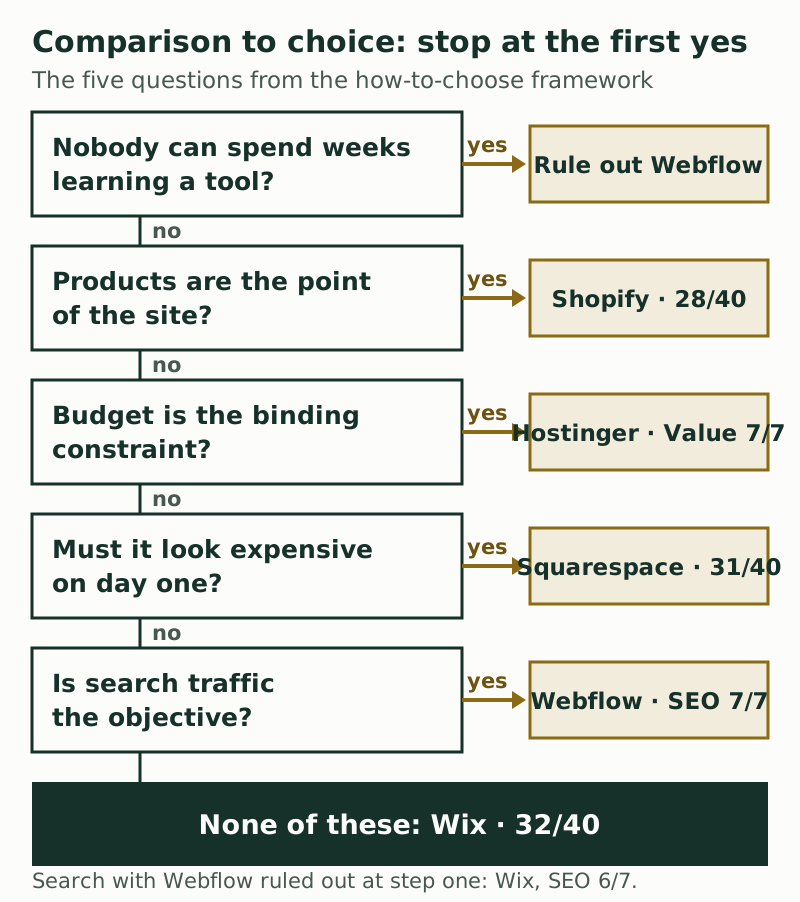
Two edge cases sit outside the path. If you expect to migrate within a few years, read the support and lock-in column first, because only Webflow lets you leave with your build. And if you are choosing on price alone, compare the renewal column and the term attached to the headline rate, not the entry price.
Scores move. This standard is re-checked monthly, and a repricing or a new performance dataset can shift a total. Revision 2026.8 is current; Hostinger's and GoDaddy's inputs are queued for the next scoring run after both line-ups changed. If a figure here is wrong, the correction procedure is published with the 40-point methodology, and corrections are logged rather than quietly edited.